
4 min read

Marketing Agency vs. Marketing Partner: What’s the Real Difference?

Marketing Agency vs. Marketing Partner: What’s the Real Difference?
7:33

Most B2B leaders eventually wrestle with a version of the same question, even if they don’t phrase it this way:

“Do we need a better marketing agency… or do we actually need a true marketing partner?”

On the surface, the difference can sound semantic. In practice, it’s the difference between marketing as a collection of activities and marketing as a system that produces predictable, compounding growth.

This distinction explains why so many capable companies have:

  • Worked with good agencies

  • Hired internal marketing coordinators

  • Invested in tools and platforms

  • Run campaigns and produced content

…and still felt uncertain about their pipeline, their positioning, and the long-term effectiveness of their efforts.

It isn’t usually a talent problem.
It isn’t an effort problem.
And it isn’t even a budget problem.

It’s a structural one.

It has to do with whether marketing is treated as an execution function that responds to requests — or as a leadership function that owns how growth actually works end to end.

Understanding that difference changes how companies evaluate outside help, how they design internal roles, and how they think about accountability for revenue over time.

That distinction is what separates hiring a marketing agency from engaging a true marketing partner.

How Most Companies Experience Marketing

In growing B2B companies, marketing is commonly structured in one of two ways.

The External Execution Model

A company hires an agency, or a collection of specialists, to help with things like:

  • Website development

  • Content and SEO

  • Email campaigns

  • Social media

  • Paid media

  • CRM and automation setup

These firms may be talented and well-intentioned. But their role is typically defined by one thing: They execute what leadership asks for.

Strategy, prioritization, and long-term direction still live with the CEO, the head of sales, or an operations leader who already has a full plate. The agency becomes an extension of internal capacity, not an owner of outcomes.

The Internal Execution Model

Other companies hire a marketing coordinator or marketing manager.

This person may handle:

  • Campaign execution

  • Content publishing

  • Website updates

  • CRM administration

  • Event support

  • Sales enablement materials

Again, useful work gets done. But the structure is similar. This role is usually designed to implement, not to architect. Authority is limited. Cross-functional ownership is rare. Responsibility for revenue impact remains indirect.

In both cases, whether the work is done by an agency or by an internal coordinator, the model is fundamentally the same:

Marketing is treated as an execution function, not as a leadership function.

Where the Execution Model Hits Its Ceiling

For a time, this works.

Early on, simply “doing marketing” is an improvement over doing nothing. Visibility increases. Activity rises. Tools get adopted. The organization feels like it’s moving forward.

But as the company grows, a different set of problems starts to appear:

  • Marketing and sales don’t quite line up

  • The CRM is in place, but not truly adopted

  • Content gets created, but not consistently leveraged

  • Messaging shifts from quarter to quarter

  • Campaigns restart instead of compounding

  • New tools are added, but the system as a whole never quite settles

Leadership feels responsible for stitching everything together, but rarely has the time to step back and design the full growth system:

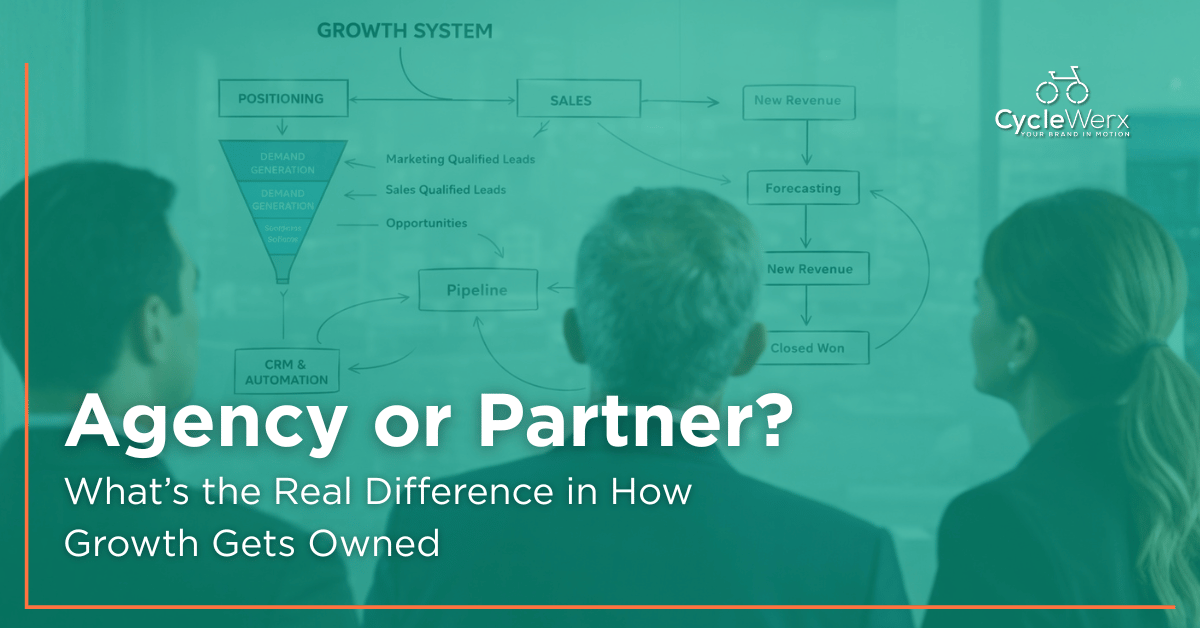
  • How positioning connects to demand generation

  • How demand generation connects to qualification

  • How qualification connects to sales process

  • How sales process connects to forecasting

  • How feedback from closed deals reshapes messaging and targeting

The result is motion without momentum.

Not because anyone is failing — but because no one truly owns the whole.

What a Marketing Partner Actually Owns

A marketing partner operates from a fundamentally different posture.

Instead of asking, “What would you like us to execute?”
They start with, “How is your growth engine supposed to work?”

Their responsibility is not limited to deliverables. It extends to:

  • Defining and maintaining positioning

  • Aligning marketing and sales around a shared revenue model

  • Designing the full buyer journey, not just the top of the funnel

  • Architecting the CRM and automation as an operating system, not a database

  • Establishing consistent planning, measurement, and improvement rhythms

  • Thinking in quarters and years, not just campaigns and sprints

This is CMO-level ownership, whether the role is held internally or provided externally.

It’s the difference between supporting activity and stewarding a system.

Execution answers, “What should we do next?”

Leadership answers, “How does everything we do fit together to produce predictable revenue over time?”

This is the same gap many companies experience when no one truly owns the marketing system end-to-end—a pattern we explored in more depth in Why B2B Growth Stalls Without Marketing Ownership.

The Hidden Cost of Staying in Vendor Mode

When marketing remains in an execution role, several things tend to persist:

  • Strategy stays trapped in the head of the CEO or sales leader

  • Sales and marketing continue to operate as adjacent functions, not as one system

  • CRM adoption remains partial and inconsistent

  • Content serves short-term needs but rarely compounds into long-term authority

  • New initiatives feel like restarts rather than progressions

Over time, this creates a subtle but real tax on the organization:

  • Leadership carries the strategic burden

  • Teams stay busy but lack a unifying growth narrative

  • Results come in bursts instead of building predictably

The issue is not the quality of execution.
It is the absence of true system ownership.

When Execution Support Is Enough

To be clear, not every company needs a marketing partner.

In very early stages, when:

  • The founder still drives most revenue

  • The go-to-market motion is simple

  • The priority is speed and experimentation

  • Budget and organizational maturity are limited

An agency or a coordinator focused on execution may be exactly the right fit.

At that stage, leadership is still forming its own point of view on the market, and formal system ownership can be premature.

When Companies Outgrow the Execution Model

A different set of signals begins to appear as organizations mature:

  • A dedicated sales team is in place

  • Pipeline consistency matters more than isolated wins

  • Lead quality becomes more important than lead volume

  • The CRM is expected to provide insight, not just storage

  • Leadership wants predictability, not just activity

  • The company wants compounding growth, not campaign spikes

At that point, the question quietly shifts from:

“Who can help us do marketing?”
to
“Who owns how growth actually works here?”

That is the moment when a company stops needing more execution and starts needing leadership.

Not another vendor.
Not just another set of hands.

But a true partner who carries responsibility for the entire growth system — positioning, process, technology, and revenue alignment — in the same way an internal CMO would.

The Real Distinction

The difference between a marketing agency and a marketing partner is not talent.
It is not effort.
And it is not even experience.

It is accountability.

Agencies and coordinators help companies do marketing.
Partners help companies own growth.

One delivers activities.
The other stewards a system.

And for organizations that aspire to predictable, compounding performance, that difference eventually becomes decisive.

Marketing Agency vs. Marketing Partner: What’s the Real Difference?

Marketing Agency vs. Marketing Partner: What’s the Real Difference?

Most B2B leaders eventually wrestle with a version of the same question, even if they don’t phrase it this way:

Read More
Why B2B Growth Stalls Without Marketing Ownership

Why B2B Growth Stalls Without Marketing Ownership

Why siloed tactics, disconnected tools, and even AI won’t fix a leadership gap in 2026.

Read More