Before You Add More AI to Your Marketing, Check These 7 Things
 Scotty Smith: Sep 30, 2026, 10:16:39 PM
AI has made it easier for a small B2B company to get marketing started.
If you only skim one section, read this:
Most B2B companies don’t struggle with marketing ideas.
They struggle with coordination.
Content gets created in bursts. Sales hears about campaigns late. Leadership can’t clearly see what marketing is working on this month — or how it connects to revenue.
Over time, this creates friction:
A content calendar fixes this — not as a publishing tool, but as a leadership system.
When built properly, a content calendar creates clarity, aligns marketing and sales, exposes capacity gaps, and turns content from isolated activity into coordinated campaigns.
After working with B2B hardware, software, and IT services companies for years, one pattern shows up consistently: when the content calendar is structured and shared, marketing performance stabilizes.
This guide will show you how to create a content calendar that works at two levels:
A content calendar is a structured plan that outlines what content your company will publish, when it will go live, who is responsible for creating it, and how it supports broader campaigns and business goals.
At a minimum, a strong content calendar includes:
A content calendar is not just a publishing schedule.
It is a coordination tool that ensures content supports campaigns, aligns with sales efforts, and fits within the team’s actual capacity.
Without one, marketing becomes reactive. With one, marketing becomes organized, predictable, and measurable.
In nearly every B2B engagement, we see the same issue: marketing activity exists, but there is no shared visibility across leadership and sales.
A content calendar is not just a marketing tool.
It is a clarity tool for the business.
It gives leadership visibility without micromanagement and creates alignment across teams.
Owners often ask:
A content calendar answers those questions in one place.
Leadership can see what’s planned, what’s in progress, and what’s launching next — without interrupting the team.
When marketing and sales operate independently, content becomes disconnected from real conversations.
A shared content calendar allows sales to:
Sales stops reacting to marketing.
Sales becomes part of the rhythm.
A content calendar forces honest capacity conversations:
Many B2B firms overcommit because ambition outpaces capacity.
A calendar makes tradeoffs visible before deadlines are missed.
Content should support:
When tied to campaigns, content becomes coordinated — not scattered.
That shift is where marketing begins supporting revenue predictably.
At a tactical level, a content calendar organizes content.
At a strategic level, it improves how marketing operates.
When structured and maintained consistently, a content calendar delivers five key benefits.
Without a calendar, content reacts to urgency.
Deadlines compress. Promotion gets rushed. Quality suffers.
A content calendar shifts marketing from reactive to planned.
Predictability improves quality and reduces stress.
Consistency builds momentum.
One blog per month for twelve months outperforms five blogs in a burst followed by silence.
If you're unsure what effective blogging actually looks like today, read our breakdown on The Reality of Blogging in 2026: What Still Works (and What Doesn’t).
A content calendar creates steady output that compounds over time.
This supports SEO, email engagement, and sales enablement consistency.
As AI search evolves, structured content planning also improves answer engine visibility — which we explain in AEO: How AI Answer Engines Are Rewriting SEO in 2026.
Each calendar item should have:
When ownership is unclear, execution drifts.
Clarity improves follow-through.
When ideas live in inboxes and Slack threads, marketing feels chaotic.
A centralized content calendar reduces noise.
Clarity improves focus.
A blog can fuel:
Planning content inside a calendar makes cross-channel reuse intentional.
Small teams compete effectively when one asset powers multiple touchpoints.

The most common failure point we see is overcommitment — ambitious content plans that collapse under operational pressure.
Before building a content calendar, define capacity.
The goal is not maximum volume.
The goal is consistent execution.
Ask:
Ignoring these realities guarantees breakdown.
SME Bandwidth
Internal experts drive B2B content. If they are overloaded, your calendar must reflect that.
Design & Production Time
Graphics, landing pages, and emails require time. Build it into the schedule.
Approval Flow
Legal or executive review adds delay. Plan for it.
Marketing Operations Support
Automation and CRM execution require configuration and testing.
A sustainable content calendar reflects operational reality.
If you cannot sustain weekly publishing, don’t commit to it.
A strong minimum cadence for many B2B firms:
Consistency builds trust.
Volume without follow-through erodes it.
Once you understand your constraints, you can build your framework.
This is where strategy becomes structure.
A strong content calendar is built in three layers:
Start with recurring commitments.
Examples:
These recurring items form the backbone of your calendar.
They create consistency and anchor your marketing cadence.
From here, you layer campaigns.
Next, identify major initiatives that must be supported.
Examples:
Each campaign should include:
Core content (blog or landing page)
Promotional emails
Social distribution
Sales enablement materials
Mapping these anchors in advance prevents last-minute compression.
It also allows marketing and sales to align messaging across channels.
Now make execution concrete.
For each calendar item, define:
Add clear deadlines for:
If ownership is not defined, execution will drift.
If deadlines are not attached, priorities will shift.
Clarity is what turns a calendar into an operational system.
Many B2B firms assume more content equals better marketing. In reality, consistent execution of a sustainable content calendar outperforms sporadic volume almost every time.
Not every company has a full marketing team.
In many B2B organizations, marketing is handled by:
That’s why your content calendar must be sustainable.
Instead of building an ambitious publishing schedule that collapses after 60 days, build a Minimum Viable Calendar — one that your team can maintain consistently.
One monthly email newsletter (if you’re rethinking your approach, see The Honest Truth About Marketing Newsletters (And Why Most Fail))
That’s it.
This may feel modest. But executed consistently over 12 months, this structure builds authority, supports SEO, and gives sales a steady stream of relevant content to reference.
For a small company, the workflow might look like this:
The key is rhythm.
The calendar becomes a monthly cycle instead of a scattered set of activities.
A Minimum Viable Calendar:
Many small B2B firms fail not because they lack ideas, but because they overcommit to volume.
Consistency builds credibility.
Sustainability builds momentum.
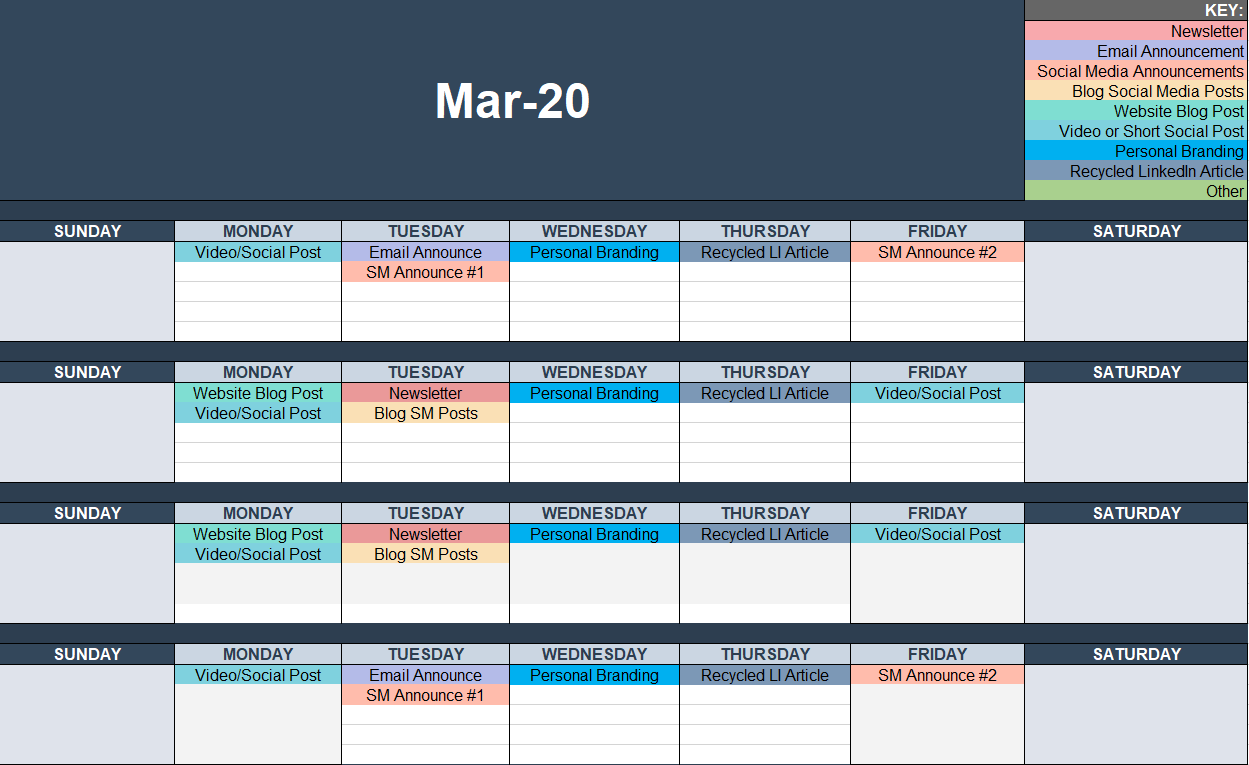
A simplified monthly content calendar designed for sustainable execution
As organizations grow, marketing complexity increases.
You may have:
In these cases, the content calendar becomes more than a publishing schedule — it becomes a coordination hub.
Even larger organizations should start with a core cadence:
Where larger organizations differentiate is in campaign layering.
For example:
Webinar Campaign Example
A single webinar may include:
When mapped in the content calendar, these pieces are scheduled backward from the event date.
Instead of promoting last-minute, the campaign unfolds over several weeks.
That is orchestration.
In larger organizations, the content calendar must integrate directly with sales activity.
For example:
When structured properly, this level of organization reduces chaos — even as activity increases.
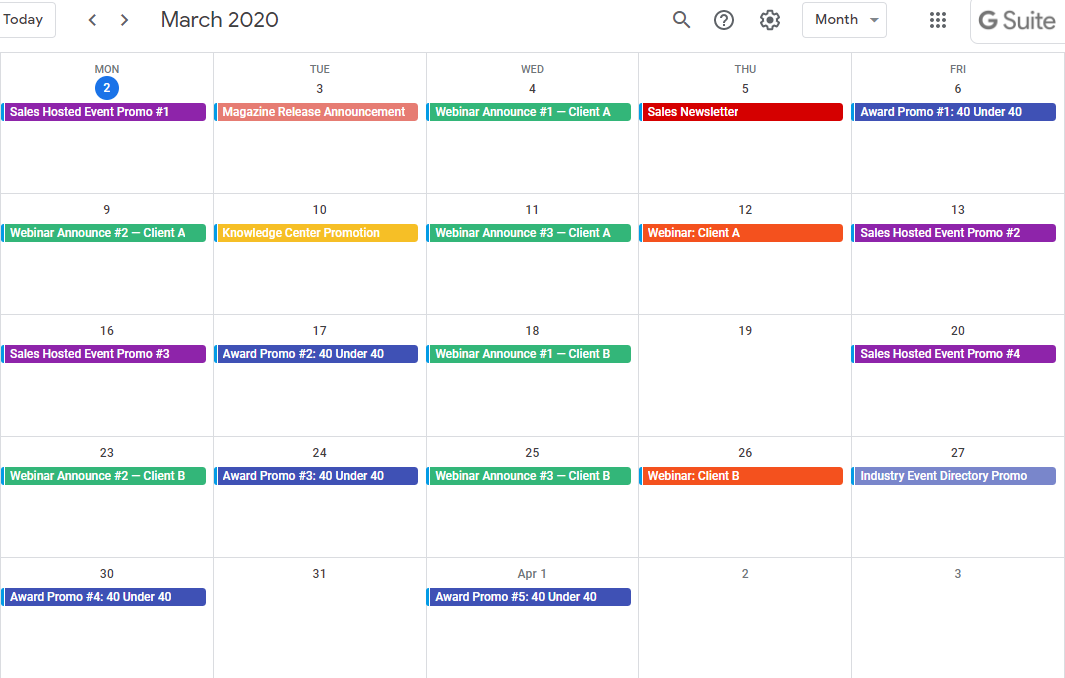
A campaign-heavy content calendar showing layered promotions, webinars, and sales coordination
The difference is not just volume.
It is layering.
Small companies focus on rhythm and sustainability.
Larger organizations layer campaigns, automation, and sales enablement on top of that rhythm.
But the underlying principle is the same:
Content must be planned in advance, tied to priorities, and owned by specific people.
Without that structure, complexity turns into confusion.
With it, marketing becomes coordinated and scalable.
A content calendar is the foundation.
Modern B2B marketing connects content to automation, reporting, and sales execution.
Where many companies struggle is integration.
Planning and execution must move together.
A webinar is not a single date.
It is a campaign that includes:
Mapping these elements in advance prevents last-minute compression.
Publishing without follow-up limits impact.
A strong content calendar allows you to pre-build:
Content and automation should be aligned before launch.
When your content calendar connects to a CRM or marketing automation platform, execution becomes measurable.
Assets are grouped.
Follow-up is automated.
Performance is visible.
The calendar becomes a system.
When sales sees the calendar:
This is where a marketing content calendar influences pipeline — not just publishing cadence.
A content calendar should be reviewed at three levels:
Without this rhythm, calendars slowly drift and lose relevance.
Consistency in review is as important as consistency in publishing.
Most B2B companies don’t fail because they lack ideas.
They fail because marketing lacks structure.
When planning is inconsistent, sales alignment weakens.
When ownership is unclear, execution slips.
When visibility is limited, leadership loses confidence.
A content calendar is not the final objective.
It is the structure that creates clarity.
When implemented consistently, it:
Reduces internal friction
In our experience, the difference between reactive marketing and coordinated growth is rarely creativity.
It’s structure.
If your marketing feels reactive, disconnected from sales, or difficult to evaluate, you don’t need more content ideas.
You need a structured content and campaign system.
At CycleWerx Marketing, we help B2B hardware, software, and IT services companies design sustainable content calendars and use HubSpot to manage execution, automation, and sales alignment as part of our broader B2B digital marketing services.
We help you build a rhythm your team can maintain.
If you’d like help creating a content calendar that supports visibility, alignment, and revenue — let’s talk.

A content calendar is a structured planning tool that outlines what content your company will publish, when it will go live, who owns it, and how it supports broader campaigns. It helps teams move from reactive marketing to consistent, coordinated execution.
At minimum: topic/title, format, owner, draft deadline, publish date, and distribution channels. Strong calendars also include campaign alignment, target audience, CTA, and related sales enablement materials.
Most B2B teams should plan 4–8 weeks ahead in detail and 1–2 quarters ahead at a theme level. This provides flexibility while still ensuring consistency and visibility.
Weekly for execution tracking, monthly for forward planning, and quarterly for strategic alignment and performance review.
Many teams start with a shared spreadsheet for visibility. Others use project management tools like Asana or Trello. When connected to platforms like HubSpot, calendars can tie directly into campaigns, automation, and reporting. Google Calendar is great for sharing a Content Calendar across an organization.
Start with a minimum viable cadence. One high-quality blog per month and one newsletter may be more sustainable and effective than inconsistent weekly publishing. Consistency matters more than volume.
It provides visibility into upcoming content, allows sales to reference relevant material in outreach, and ensures marketing campaigns align with active sales conversations.
 Scotty Smith: Sep 30, 2026, 10:16:39 PM
AI has made it easier for a small B2B company to get marketing started.

 CycleWerx Marketing: Sep 11, 2026, 1:46:19 PM
Client: Bender CFO Services | Industry: Fractional CFO and Financial Advisory Services
 Scotty Smith: Aug 26, 2026, 3:50:05 PM
Many growing B2B companies have people helping with marketing but still do not have anyone truly running marketing.