When Should a Small B2B Company Outsource Marketing Leadership?
 Scotty Smith: Jul 22, 2026, 8:56:24 PM
If you own a small B2B company, there is a good chance marketing still depends on you far more than it should.

Most B2B companies have more marketing and sales data than ever — and less clarity than they should.
This post breaks down a simple, owner-level dashboard you can review monthly, and the seven metrics that matter most.
If you’re a B2B owner or executive, there’s a good chance you’ve had this moment:
You’re in a leadership meeting.
Someone asks, “Is marketing working right now?”
And the answers sound like:
“Traffic is up… I think.”
“Leads are coming in, but sales says they’re not great.”
“Pipeline looks okay, but it feels slower than last quarter.”
“We should probably look at the reports.”
Most companies aren’t failing at marketing because they’re doing nothing.
They’re failing because no one has a clear, shared view of what’s actually happening.
You don’t need more dashboards.
You don’t need attribution modeling.
You don’t need a 40-page report no one reads.
You need one simple, owner-level dashboard you can review in under an hour each month — and use to ask better questions.
That’s what this article is about.
Before we go any further, let’s level-set.
This is not:
a campaign optimization dashboard
a sales activity scoreboard
a marketing ops deep dive
a reporting science project
An owner dashboard is:
directional, not perfect
focused on trends, not snapshots
designed to connect marketing → sales → revenue
something leadership can review consistently
Think of it as a monthly clarity check, not a diagnostic.
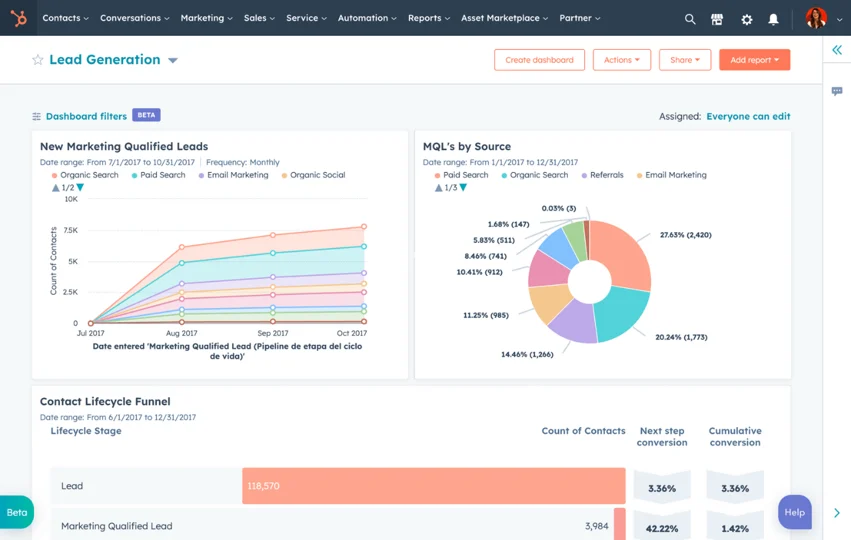
Example: An owner-level HubSpot dashboard showing lead flow, qualification, and source trends.
Most companies already have this data in HubSpot — it’s just scattered across reports no one reviews together.
An owner dashboard pulls the most important signals into one place.
You don’t need dozens of KPIs.
You need a short list that forces clarity.
Here are the seven metrics I recommend reviewing every month.
The question it answers:
Are we generating demand right now?
If this number is flat or declining, everything downstream will suffer.
The question it answers:
Are our leads getting better or worse?
Most companies have lifecycle stages in HubSpot. Very few actually review them.
The question it answers:
Is demand turning into sales conversations?
If leads rise but deals don’t, something is breaking in the handoff.
The question it answers:
How much potential revenue did we create this month?
Owners care about what’s coming, not just what closed.
The question it answers:
Is our pipeline healthy — or just noisy?
A declining win rate often points to lead quality or positioning issues.
The question it answers:
Are deals stalling?
Speed is a signal. When it changes, it’s worth paying attention.
The question it answers:
Is our audience paying attention at all?
You don’t need to analyze every campaign — just the trend.
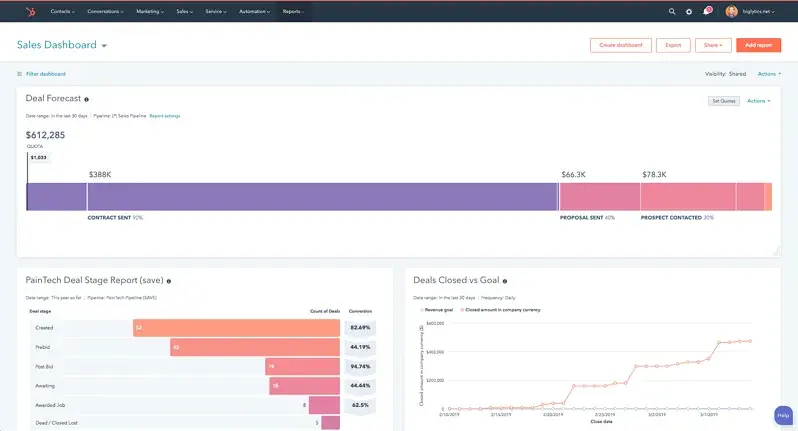
Example: Tracking pipeline value, deal stages, and revenue momentum inside HubSpot.
This is where clarity usually breaks down.
Marketing looks at leads.
Sales looks at deals.
Leadership tries to connect the dots.
A shared dashboard replaces opinion with visibility.
In theory, this dashboard should be easy to build. HubSpot already has the data. The reports already exist.
In practice, it rarely happens because no one owns the system end-to-end. Marketing looks at lead volume. Sales looks at deals. Leadership looks at revenue — and no one connects the dots consistently.
The problem isn’t tools.
It’s ownership.
Once a month.
Same dashboard.
Same questions.
Over time:
trends become obvious
conversations improve
decisions get faster
Consistency beats sophistication every time.
This is exactly the kind of gap we help close at CycleWerx Marketing.
Our role isn’t to flood teams with reports or over-engineer dashboards. It’s to simplify what matters, wire systems together properly, and create a rhythm leadership can actually stick to.
That usually means:
turning scattered HubSpot data into a single owner view
aligning marketing and sales around the same numbers
and making sure someone is accountable for reviewing them monthly
When that happens, conversations get better — and decisions get faster.

 Scotty Smith: Jul 22, 2026, 8:56:24 PM
If you own a small B2B company, there is a good chance marketing still depends on you far more than it should.

 CycleWerx Marketing: Jun 29, 2026, 11:52:33 PM
Client: Privacy4Cars | Industry: Automotive Data Privacy, Dealer Services & B2B SaaS
 Scotty Smith: Jun 22, 2026, 5:20:55 PM
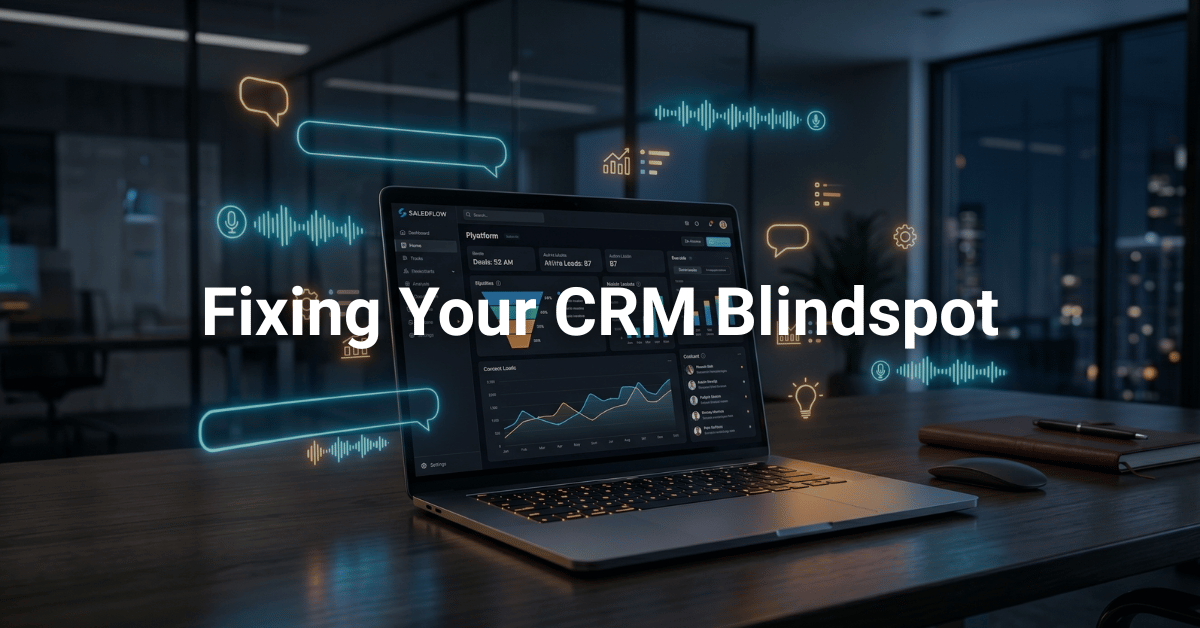
Most B2B companies don't have a lead problem. They have a visibility problem. Sales reps know things the CRM doesn't.