How HOPE Network Built a Scalable HubSpot Revenue Operations System
 Scotty Smith: Oct 18, 2026, 5:01:50 PM
Client: HOPE Network — HOPE Prison Ministries + HOPE For Everybody | Industry: B2B Membership Network & Nonprofit Services
Client: HOPE Network — HOPE Prison Ministries + HOPE For Everybody | Industry: B2B Membership Network & Nonprofit Services
Services Provided: HubSpot Sales Hub Enterprise Implementation, CRM Architecture, Apollo Integration, Sales Automation, Territory Routing, Reporting, and Sales Enablement

HOPE was preparing to make a significant change in how the organization grew.
Alongside its established nonprofit operations, leadership was launching HOPE For Everybody: a revenue-generating membership network connecting service providers with people and organizations seeking assistance.
The concept created an entirely new go-to-market challenge. HOPE needed to recruit and onboard providers, manage subscription relationships, support multiple sales territories, and operate a growing outbound sales organization.
The technology was there. The operating system behind it was not.
CycleWerx Marketing was brought in to design that system — transforming newly purchased technology, fragmented data, and manual sales activity into a structured HubSpot-powered revenue operations platform.
“Scotty and the CycleWerx team helped us establish both organizations and operations in HubSpot. They cleaned up complex databases, built custom workflows and reporting, and trained our team to use the system day to day.
What stood out was Scotty’s deep knowledge, flexibility, and focus on practical execution. We were genuinely set up for long-term success, not just short-term activity.”
— Chandler Fozard
Founder & President, HOPE Ministries
HOPE had purchased HubSpot Sales Hub Enterprise and Marketing Hub Professional, but implementation involved much more than configuring software.
The organization was simultaneously introducing a new business model, developing its sales process, building a sales team, and bringing together several very different types of CRM data.
The scale added another layer of difficulty:
There was also an unusual architectural requirement.
HOPE needed one CRM environment to support both its established nonprofit operations and the commercial membership network without mixing fundraising activity, service recipients, volunteers, provider prospects, and subscription revenue into one reporting structure.
Simply “setting up HubSpot” would not solve that.
CycleWerx first had to determine how the organization should operate inside HubSpot.
CycleWerx Founder Scotty Smith led the strategic architecture and cross-functional implementation, working with HOPE executives, sales users, administrators, and outside technology partners to translate the organization's business processes into a scalable CRM structure.
A master data model was created to distinguish different record types and organizational segments while preserving shared information such as contact details, ownership, and communication history.
That architecture supported providers, clients, donors, volunteers, foundations, and other stakeholders without allowing non-revenue records to distort the commercial sales funnel.
CycleWerx also designed HOPE's revenue lifecycle.
Provider prospects could move systematically from Lead to Marketing Qualified Lead, Sales Qualified Lead, Opportunity, and eventually Customer, while non-commercial records were intentionally isolated from revenue reporting.
For sales representatives, a second operational layer tracked the work being done: researching, attempting contact, engaging, qualifying, nurturing, or disqualifying a prospect.
The objective was not to create more CRM fields.
It was to make the CRM reflect how the organization needed to sell.
Having 120,000 company records was not particularly useful when fewer than 5,000 contained verified contact emails.
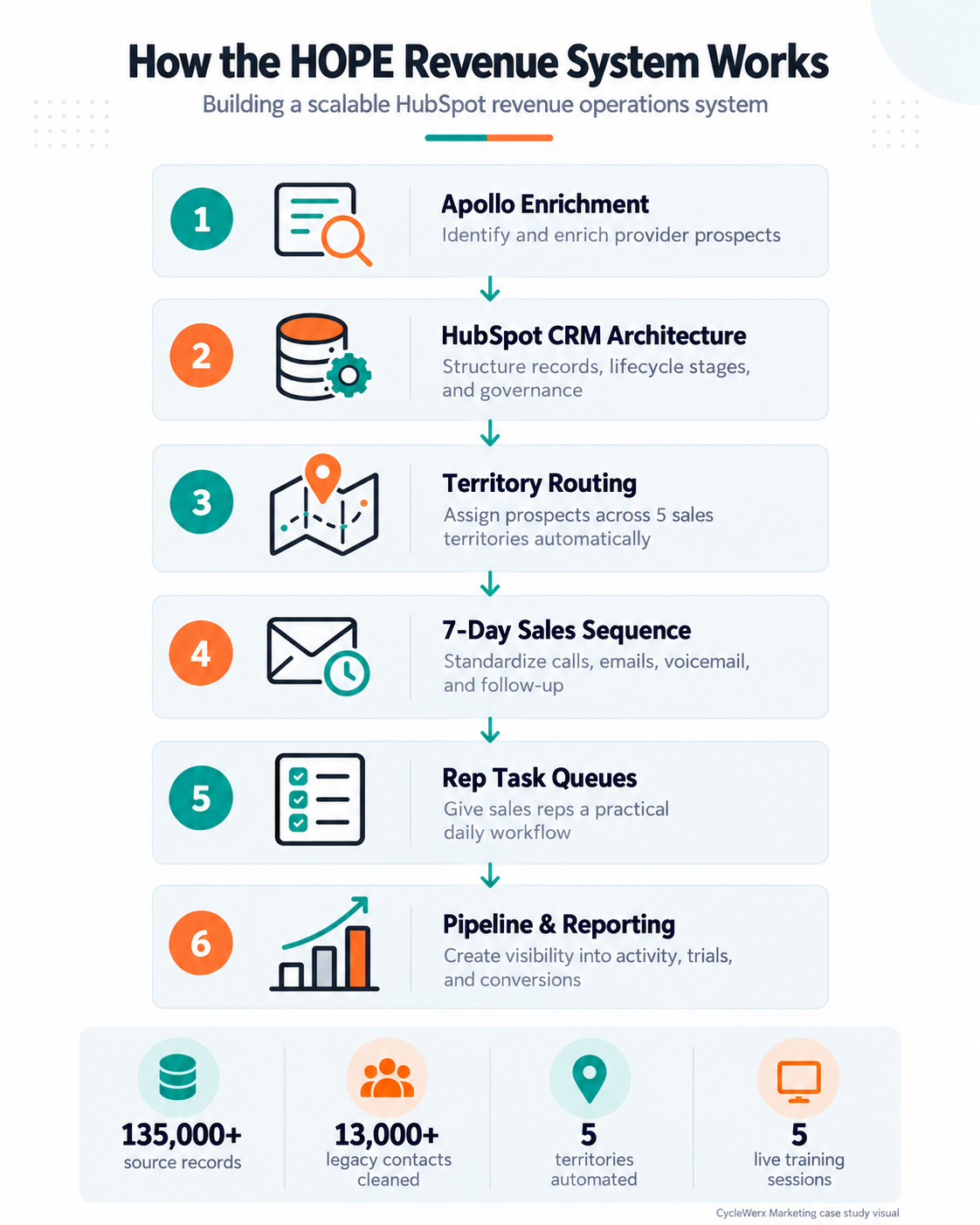
CycleWerx integrated Apollo with HubSpot and structured a shared prospecting environment that allowed researchers and sales representatives to identify decision-makers, enrich company records with direct contact information, and push qualified prospects into HubSpot.
The next challenge was deciding where those prospects should go.
CycleWerx built automated geographic-routing workflows across five sales territories. Instead of manually compiling, dividing, and distributing prospect spreadsheets, records could move automatically into the appropriate representative's working queue.
CycleWerx then designed a standardized seven-day outbound cadence combining HubSpot calling, voicemail, automated emails, follow-up tasks, meeting scheduling, and automatic sequence exit rules when a prospect responded.
A process that had depended on paper lists, manually copied emails, and individual rep habits became a structured and trackable sales motion.
CycleWerx also developed a sales-capacity model around an initial 2,870-record qualified target list, giving leadership a practical way to estimate the representative hours required to work the market instead of setting activity expectations by guesswork.
One of the most important decisions involved HOPE's existing database.
More than 13,000 legacy contacts had been created without a consistent CRM architecture. Classification fields were missing, geographic data was inconsistent, and records could not be reliably segmented.
Trying to repair every record manually inside HubSpot would have created substantial administrative work while leaving plenty of room for inconsistencies.
CycleWerx recommended a different approach.
The legacy data was exported, standardized against the new property architecture, cleaned and classified outside the CRM, and then re-imported into the new structure.
That restored reliable segmentation and supported the automated territory-routing system.
The same discipline produced a direct cost-control win. Before a regional campaign launched, CycleWerx validated a 2,400-record email list and reduced it to approximately 1,700 deliverable contacts, keeping the account below HubSpot's 2,000-marketing-contact tier and avoiding an unnecessary subscription increase.
It demonstrated an important principle behind the engagement:
The goal was not to preserve the existing process. The goal was to design the right one.
Even a well-designed revenue system fails when the people expected to use it do not understand it.
HOPE's sales organization included users with widely different levels of CRM and technical experience. CycleWerx therefore treated enablement and change management as part of the implementation rather than something to address after launch.
CycleWerx delivered five live virtual training sessions, created role-specific sales and process documentation, embedded calling guidance inside HubSpot, and adapted contact records so representatives could quickly understand previous interactions before making a call.
The change was visible in everyday behavior. Representatives moved from paper lists and manually copied emails to HubSpot task queues, automated sequences, recorded activity, and integrated meeting scheduling.
CycleWerx also established practical data-governance rules so representatives could properly disqualify and suppress records without destroying CRM history.
The result was not simply a configured platform.
It was a sales operating system people could actually work inside.
By the end of the engagement, HOPE had moved from fragmented sales activity and unstructured CRM data to an integrated revenue operations foundation.
The transformation is easier to see side by side:
| Area | Before | After |
|---|---|---|
| CRM Structure | Fragmented records, inconsistent classification, and no unified operating structure. | Standardized architecture supporting 135,000+ records across commercial and non-revenue operations. |
| Lead Routing | Prospect lists were manually compiled, divided, and distributed. | Automated geographic routing assigned prospects across five sales territories. |
| Prospecting | Paper lists, manually copied emails, inconsistent calling, and limited verified contact data. | Apollo enrichment, HubSpot calling, automated sequences, follow-up tasks, and integrated scheduling. |
| Data Quality | 13,000+ legacy contacts lacked consistent ownership, lifecycle, classification, and geographic data. | Legacy records were standardized, segmented, and rebuilt to support automation and reporting. |
| Sales Visibility | Leadership had limited visibility into activity, pipeline progression, trials, and conversions. | HubSpot created centralized visibility into sales activity, lifecycle progression, pipeline, and follow-up. |
| User Adoption | Sales users had varying technical experience and no established enterprise CRM workflow. | Five live training sessions, role-specific documentation, task queues, sequences, and embedded sales guidance supported day-to-day adoption. |
Just as important, leadership no longer had a collection of disconnected tools, spreadsheets, and lists.
They had a system designed around how the organization intended to grow.
Buying HubSpot does not automatically create a revenue operating system.
Growing organizations still have to answer harder questions:
Who owns each prospect? What does qualification actually mean? How should data be structured? When should automation take over? How should salespeople work inside the CRM? What should leadership be able to see?
Those are business-process and operating-model questions before they are software questions.
CycleWerx helps growing B2B companies connect strategy, CRM architecture, automation, prospecting, sales enablement, and practical execution so HubSpot becomes part of how the business operates — not another tool the team has to manage.
If your team is facing similar challenges, the next step is to look at how your current revenue system is actually working.
 Scotty Smith: Oct 18, 2026, 5:01:50 PM
Client: HOPE Network — HOPE Prison Ministries + HOPE For Everybody | Industry: B2B Membership Network & Nonprofit Services
 Scotty Smith: Sep 30, 2026, 10:16:39 PM
AI has made it easier for a small B2B company to get marketing started.

 CycleWerx Marketing: Sep 11, 2026, 1:46:19 PM
Client: Bender CFO Services | Industry: Fractional CFO and Financial Advisory Services