When Should a Small B2B Company Outsource Marketing Leadership?
 Scotty Smith: Jul 22, 2026, 8:56:24 PM
If you own a small B2B company, there is a good chance marketing still depends on you far more than it should.
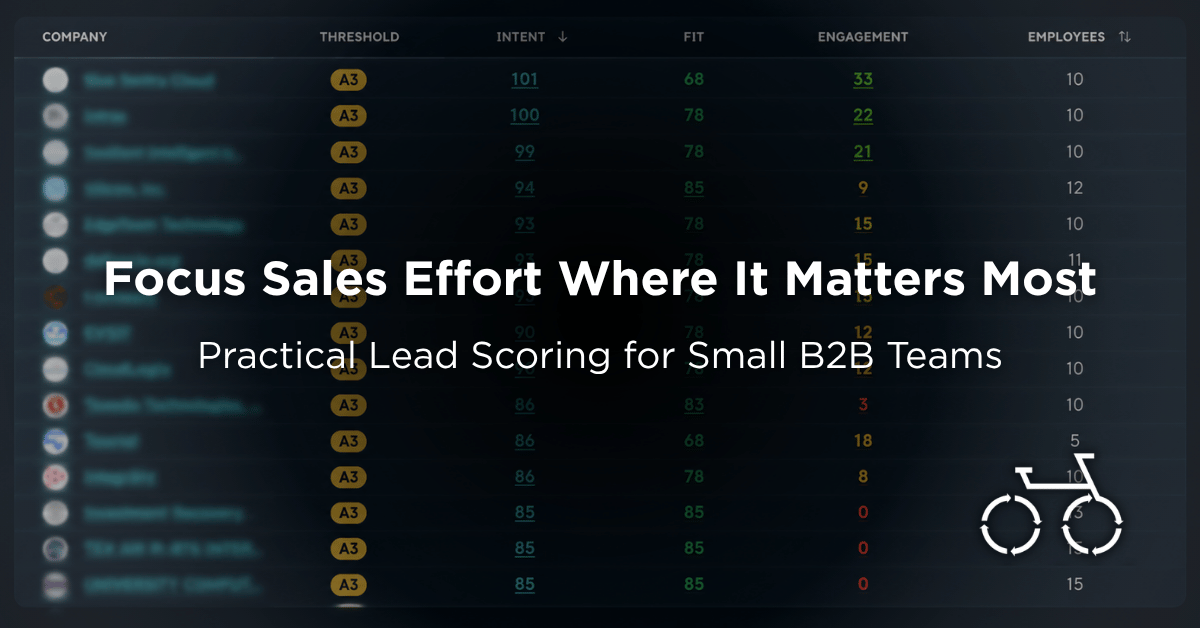
Most B2B Companies Don’t Have a Lead Problem
They have a sales focus problem.
For many small B2B teams, the challenge isn’t finding companies to sell to
It’s figuring out where to spend limited sales time.
Questions like:
Who should we follow up with first?
Who deserves a phone call?
Who should stay in a sequence?
Which companies are actually showing signs they may buy?
And which contacts are probably wasting our time?
That problem gets bigger as the CRM grows.
At some point, most small sales teams hit the same wall:
We have plenty of companies and contacts… but we don’t know who deserves attention right now.
We see this constantly with founder-led companies and lean sales teams.
One client recently explained it perfectly.
He knew he needed to spend more time on outreach, but he didn’t know:
which companies deserved the effort first
which contacts were worth picking up the phone for
or where his limited sales time would create the best return
That’s exactly the kind of problem lead scoring is supposed to solve.
Not as a theoretical marketing exercise.
As a practical sales prioritization system.
We recently rebuilt our own HubSpot company lead scoring model at CycleWerx Marketing for the same reason.
Not because we wanted cleaner reports.
Because we needed better pipeline focus. Fast.
What we found is this:
Lead scoring is not about assigning points.
It’s about deciding who deserves your attention.
And for small B2B teams, it’s usually much simpler to implement than people expect.
Most small B2B companies don’t think they need lead scoring.
It sounds like something built for:
large sales teams
RevOps departments
and complex enterprise systems
But in reality, lead scoring becomes even more valuable when your team is small.
If you’re a founder or part of a lean sales team, your biggest constraint usually isn’t data.
It’s time.
You don’t have time to:
review every company in your CRM
guess who might be a good fit
send the same outreach to everyone
or follow up consistently across hundreds of contacts
That’s what lead scoring is trying to solve.
At its core, lead scoring answers one question:
Who deserves our attention right now?
A strong lead scoring model helps teams:
For many small B2B teams, that’s a major shift.
Before you assign a single point in a lead score, you need clarity on one thing:
Who are you actually trying to sell to?
This is your Ideal Customer Profile (ICP).
Your ICP defines:
the companies most likely to buy
the companies most likely to get value
and the companies actually worth your team’s time
Lead scoring only works if it reflects that reality.
This is where many small B2B companies go wrong.
They build scoring models around:
companies that look impressive
larger organizations they hope to land
or markets they want to break into someday
Instead of:
companies that actually engage
companies that actually close
and companies that move in a reasonable timeframe
For small teams, this matters a lot.
You don’t have the luxury of chasing long-shot opportunities.
Your lead scoring model should reflect:
who is most likely to move quickly
who has real urgency
and who fits your business today—not just where you want to be later
That’s why lead scoring is not just a technical setup.
It’s a reflection of your business model.
One of the biggest mistakes in lead scoring is assuming every good-fit company should be approached the same way.
Not all “good-fit” companies behave alike.
As company size changes, the buying process often changes with it.
Smaller companies often:
move faster
have fewer decision-makers
respond more directly to outreach
feel revenue pressure more immediately
and make decisions closer to the owner or leadership team
As companies grow, the sales process usually becomes more layered.
Larger organizations often involve:
more internal alignment
additional stakeholders
longer evaluation cycles
more structured decision-making
and greater operational complexity
That doesn’t make larger companies bad targets.
But it does mean:
the sales motion may change
the timeline may change
and the level of outreach effort may need to change as well
Your lead scoring model should account for that reality.
A company can still be a strong fit while requiring a very different sales approach.
This is where things got real for us.
Our original strategy leaned upmarket:
larger companies
bigger opportunities
longer-term vision
On paper, it made sense.
But our actual client history told a different story.
We consistently saw:
stronger engagement
faster conversations
and quicker closes from smaller companies
That forced a shift in how we approached lead scoring.
Instead of scoring for “ideal someday clients,” we started scoring for companies more likely to buy now.
That mindset change made the scoring model significantly more useful.
A realistic opportunity that closes is more valuable than a theoretical perfect-fit company that never moves forward.
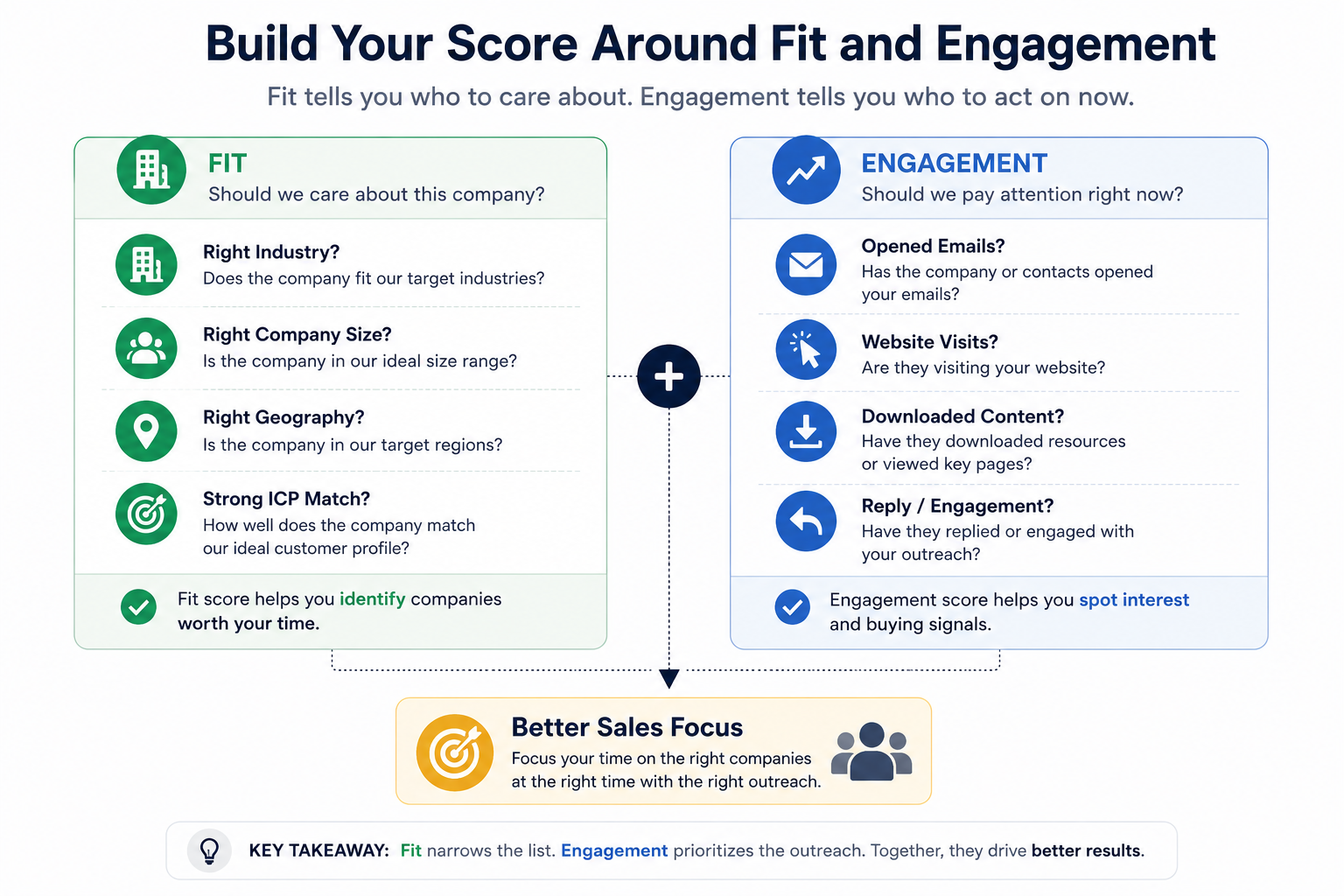
Most lead scoring models revolve around two core ideas:
Fit → Is this the kind of company we actually want to work with?
Engagement → Are they showing signs of interest or buying activity?
Both matter.
But they solve different problems.
This is also where the flexibility of HubSpot-based company lead scoring and CRM systems becomes incredibly valuable for growing B2B teams.
Is this company aligned with our ICP?
Are they realistically capable of becoming a good client?
Do they match the industries, size, geography, or operational traits we care about?
A strong fit score helps prevent teams from wasting time on companies that may engage—but are unlikely to close.
Are they interacting with emails, content, or outreach?
Are they showing signs of curiosity or buying intent?
Is this a company we should pay more attention to right now?
Engagement helps surface timing.
And timing matters.
A perfect-fit company with zero engagement may still deserve outbound attention.
Meanwhile, a highly engaged company that’s a poor fit may never become a strong opportunity.
That’s why both sides of the score matter.
One helps answer:
“Should we care about this company at all?”
The other helps answer:
“Should we pay attention right now?”
In HubSpot, these often combine into score groupings like:
A1, A2, A3
B1, B2, B3
C1, C2, C3
The letter reflects fit.
The number reflects engagement.
Here’s what surprised us:
Many of our best companies initially showed up as A3—not A1 or A2.
That didn’t mean the scoring model was broken.
It meant:
strong company fit
lower current engagement
And that’s an important distinction.
A3 is not automatically bad.
It may simply mean the right company hasn’t engaged yet.
For many small B2B teams, that becomes the working outreach list.
This article focuses specifically on company lead scoring inside HubSpot.
That distinction matters.
For many small B2B teams, company-level scoring is often more useful for sales prioritization because buying decisions usually happen at the account level—not just the contact level.
In other words:
Is this company a strong fit?
Does this business match our ICP?
Is this organization showing signs of buying intent?
Those questions often matter more than the activity of a single individual contact.
HubSpot also supports contact-based lead scoring, which is commonly used for marketing qualification, inbound activity, and individual engagement tracking.
Both can be valuable.
But for small B2B sales teams trying to decide:
“Who deserves a call today?”
company lead scoring is often the better operational starting point.
One thing we learned quickly:
Lead scoring is highly dependent on operational details.
The scoring model itself may look simple on paper, but real-world execution can get complicated fast.
The devil is in the details.
Small setup decisions can unintentionally skew lead scoring results.
That doesn’t mean lead scoring is unreliable.
It means the model depends heavily on:
clean data
consistent properties
thoughtful segmentation
and operational logic
Even small inconsistencies can create problems that aren’t immediately obvious.
For example:
We added extra scoring weight for:
That aligned with our short-term sales strategy.
But it also created a side effect.
National companies became less likely to reach top score buckets—not because they were bad-fit companies, but because they missed the regional scoring bonuses.
That forced us to rethink how we handled monitoring and segmentation.
Simple inconsistencies can break filtering logic.
One real example:
Some company records used:
“Texas”
Others used:
“TX”
At first glance, that seems harmless.
But segmentation filters behaved differently depending on the value.
That caused companies to appear in the wrong segments until the logic accounted for both.
This was another major lesson.
We initially tried to combine:
company scoring
outreach eligibilitysequence enrollment
and associated contact exclusions
inside the same segments.
The result:
overly complicated filters
broken segment counts
and lists returning zero results
Separating company segments from contact eligibility segments made the system much cleaner and easier to manage.
One incorrect boolean filter completely changed one of our outreach lists.
Instead of excluding contacts already enrolled in sequences, the filter accidentally prioritized them.
The segment dropped from a healthy list to almost nothing.
That’s why testing and validating list logic matters.
Lead scoring becomes less useful when the CRM contains companies that were never realistic targets to begin with.
During cleanup, we found a large number of companies outside North America.
Since those companies were outside our actual selling region, they added noise instead of value.
In some cases, improving lead scoring is less about adding complexity—and more about removing bad-fit data.
Most lead scoring problems are not caused by scoring formulas.
They’re caused by inconsistent operational data, bad CRM data, and segmentation issues that quietly distort reporting and visibility over time.
Lead scoring becomes much more valuable once it starts changing behavior.
This is where many small B2B teams stop too early.
They build a score…
But never change:
outreach priorities
follow-up strategy
segmentation
or sales focus
That limits the value of the entire system.
A lead score by itself doesn’t improve pipeline.
What matters is:
how the sales team responds to the score
where sales attention gets directed
and which companies deserve different levels of effort
That’s where segmentation becomes powerful.
Instead of treating every company the same, lead scoring helps group companies into different sales motions.
We started referring to these groups as “lanes.”
Each lane represented:
a different level of priority
a different outreach motion
and a different amount of sales attention
For founder-led teams and lean sales organizations, this creates structure.
Instead of:
chasing random follow-ups
reacting to whoever replied last
or working from memory
the CRM starts helping guide daily sales decisions.
This is also where stronger sales operations and enablement systems can dramatically improve sales consistency and follow-up.
The score itself doesn’t decide everything.
It helps route companies into the right sales motion.
If every lead receives the same level of attention, your lead scoring system isn’t changing behavior.
From there, we built several core lanes.
Here’s a simplified example of how lead scoring can route companies into different sales motions and outreach priorities.
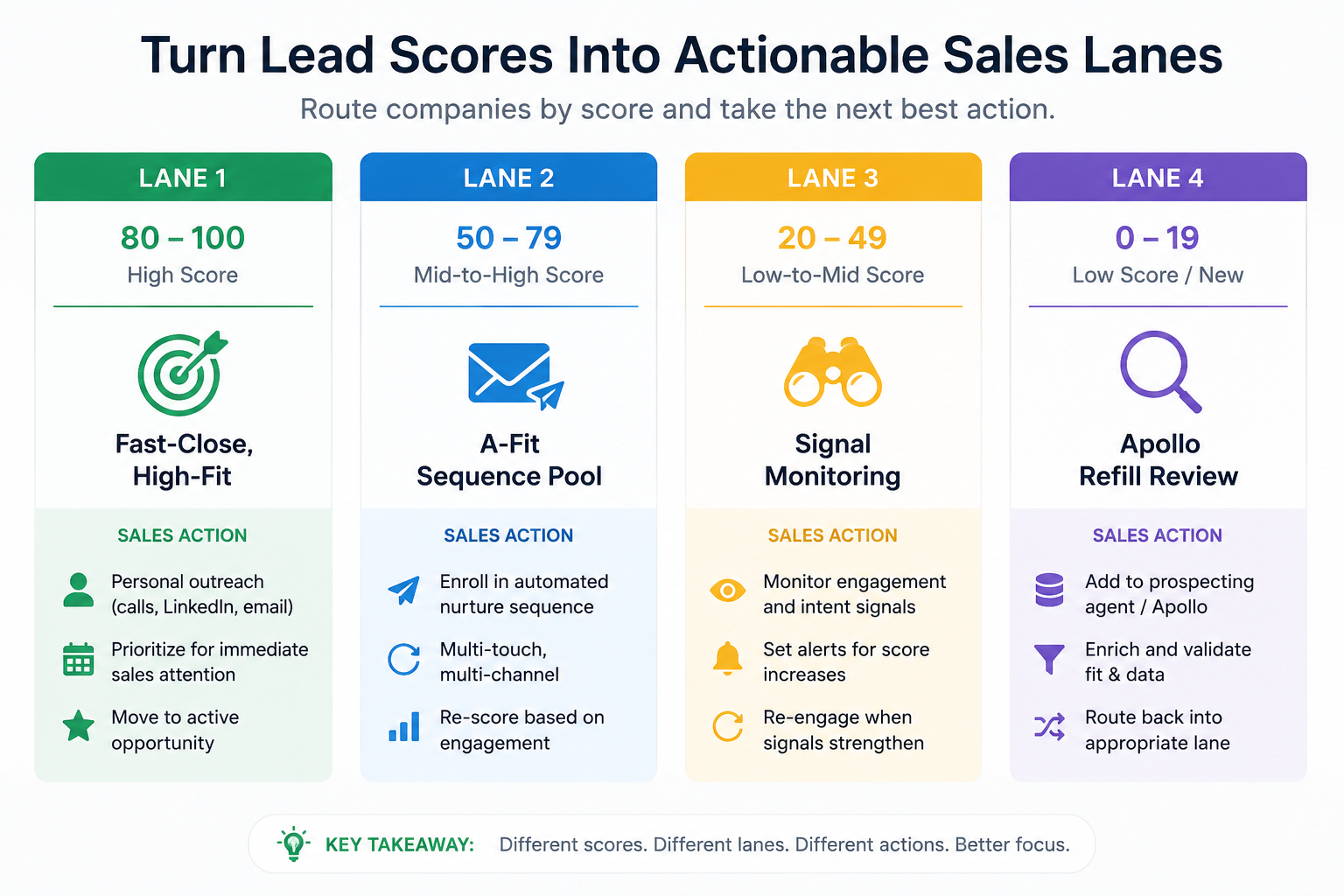
This lane focused on companies that:
closely matched our ICP
appeared more likely to move quickly
and justified higher-touch outreach
These companies received the most personalized sales attention and became the highest-priority outreach group.
Not every strong-fit company requires highly personalized outreach.
Lane 2 supported companies that still aligned well with the ICP, but were better suited for:
scalable sales sequences
structured follow-up
and repeatable outreach motions
Still strong opportunities.
Just a different sales motion.
Some companies showed potential, but didn’t deserve immediate outreach effort yet.
Instead of forcing outreach too early, this lane focused on monitoring:
engagement activity
buying signals
website visits
and email interaction
This helped surface companies that might become stronger opportunities later.
Lead scoring only works if the database continues improving over time.
Lane 4 became the intake lane for newly imported companies from Apollo, our B2B prospecting database.
This gave us a place to:
review data quality
validate fit
confirm scoring
and route companies into the appropriate lane
Without a consistent refill process, even strong lead scoring systems eventually lose momentum.
For many small B2B teams, this is where lead scoring finally becomes operational.
Not just:
scores
dashboards
or reports
But a practical system for deciding:
who deserves attention
how outreach should happen
and where sales energy should go next
Once companies are segmented, sales prioritization becomes much clearer.
Not every company deserves the same level of effort.
That’s one of the biggest benefits of lead scoring.
Instead of treating every prospect the same, the score helps determine:
who deserves personalized outreach
who belongs in scalable sequences
who should be monitored
and who still needs review or cleanup
For example:
High-fit companies → personalized outreach and direct sales attention
Mid-fit companies → structured sequences and repeatable follow-up
Lower-fit or early-stage companies → monitoring for future buying signals
Newly imported companies → review, validate, and route into the appropriate lane
This creates better focus for small sales teams
Sales energy becomes intentional instead of reactive.
That structure becomes much easier to manage once your team has a repeatable B2B sales process tied to clear outreach motions and follow-up expectations.
If every company receives the same follow-up, your lead scoring system isn’t doing its job.
The goal is not to automate everything equally.
The goal is to match the right level of sales effort to the right opportunity
For founder-led companies and lean sales teams, lead scoring is really about focus.
Most small B2B teams don’t have:
dedicated RevOps staff
large sales departments
or unlimited time for follow-up
That means sales attention becomes one of the company’s most valuable resources.
Without structure, outreach often becomes reactive:
whoever replied last
whoever opened an email
whoever someone happens to remember to follow up with
This is also why many small sales teams stay busy without making real pipeline progress.
Lead scoring helps create a more intentional system.
It helps answer questions like:
Who deserves a call today?
Which companies should stay in active follow-up?
Which prospects belong in sequences instead of high-touch outreach?
Where is pipeline most likely to come from right now?
For many small B2B companies, that clarity is incredibly valuable.
Lead scoring turns the CRM from a database into a daily decision tool.
The goal of lead scoring is not perfection.
It’s better decision-making.
A strong lead scoring model helps teams decide:
who to contact
who to prioritize
who belongs in sequences
who should be monitored
and which companies probably shouldn’t consume sales energy right now
More importantly, it helps sales and marketing operate with more focus and consistency.
That’s where the real value comes from.
Not the score itself…
But the decisions the score helps support.
The score is not the strategy.
The score supports the strategy.
For many small B2B teams, that shift alone can completely change how outreach, follow-up, and pipeline development are managed.
If your CRM is full of companies but you’re not sure:
who to prioritize
where sales attention should go
or how to turn that data into real pipeline
that’s usually where we start.
We work with B2B hardware, software, and IT services companies to build more practical marketing, CRM, and sales systems that help teams focus, follow up consistently, and generate stronger pipeline.
👉 Book a quick conversation and we’ll walk through how you’re currently prioritizing outreach—and where the process may be breaking down.
 Scotty Smith: Jul 22, 2026, 8:56:24 PM
If you own a small B2B company, there is a good chance marketing still depends on you far more than it should.
 CycleWerx Marketing: Jun 29, 2026, 11:52:33 PM
Client: Privacy4Cars | Industry: Automotive Data Privacy, Dealer Services & B2B SaaS
 Scotty Smith: Jun 22, 2026, 5:20:55 PM
Most B2B companies don't have a lead problem. They have a visibility problem. Sales reps know things the CRM doesn't.